Adding veterinary dental equipment to an existing clinic is different from planning a completely new treatment room. Floor space, power supply, access to compressed air, water management and the movement of staff and patients have already been defined. A suitable mobile veterinary dental treatment table should therefore provide the required dental functions without demanding major changes to the clinic.
This guide explains the main points to evaluate before purchasing a mobile veterinary dental table or cart for a small animal clinic, veterinary hospital or established pet clinic.

An established clinic usually needs to add dental treatment capacity without interrupting its current workflow. A large fixed installation may require additional plumbing, compressed-air lines or room renovation. A compact mobile unit can be easier to place in a treatment room and move when the space is needed for another procedure.
Before comparing individual instruments, first confirm where the equipment will be used, how often it must be moved and which utilities are already available. These decisions determine whether a self-contained mobile unit or a larger integrated workstation is the better choice.
Check both the operating position and the route used to move the unit. Record the width of doors, corridors and spaces between existing equipment. The product dimensions alone are not enough: hoses, instrument holders, lights and accessories may require additional clearance during use.
Air-driven dental handpieces require a stable air supply. If the clinic does not already have a suitable compressed-air connection in the treatment room, a unit with a built-in oil-free air compressor can reduce installation work and avoid the need for a separate external compressor.
When evaluating the compressor, ask the supplier to confirm its rated power, air-tank specification, working pressure, noise level and compatibility with the selected high-speed and low-speed handpieces. Do not assume that every handpiece is included in the standard package.
A self-contained clean water bottle and waste water bottle can make the unit easier to add to a room without fixed plumbing. Confirm the bottle capacity, bottle position, removal method and cleaning procedure. Staff should be able to refill and empty the bottles without moving other equipment.
Ask whether the water system supplies the scaler, 3-way syringe and handpiece connections in the selected configuration. The supplier should also explain the recommended flushing, cleaning and maintenance procedures.
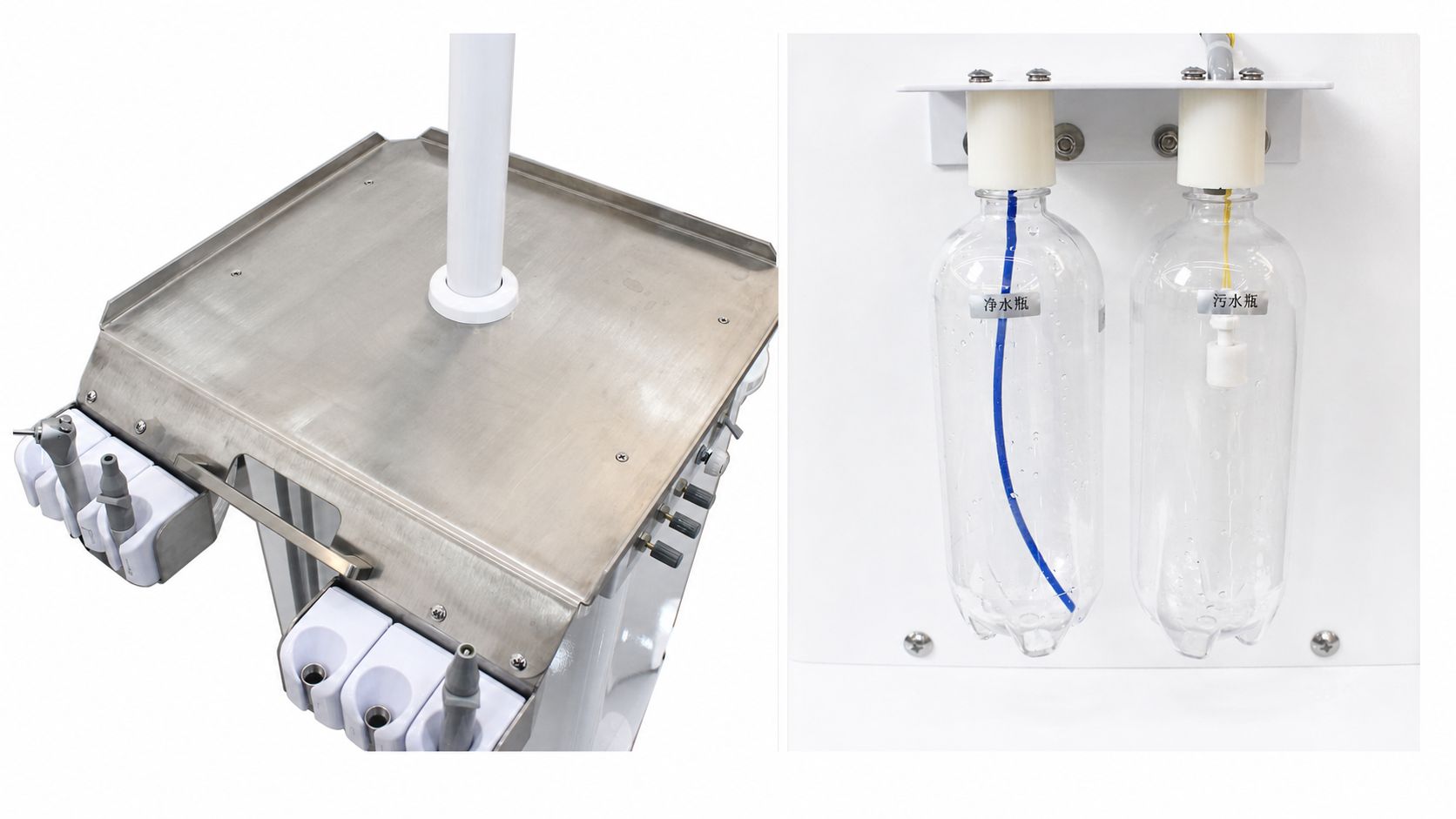
Product photos often show a fully configured unit, while the quotation may include only the base equipment. Ask for a written configuration list that clearly identifies every item as standard, optional or unavailable.
A mobile veterinary dental treatment table may support:
Confirm which procedures the clinic intends to perform and select only the equipment required for that workflow. This keeps the initial configuration clear and avoids paying for accessories that will not be used.
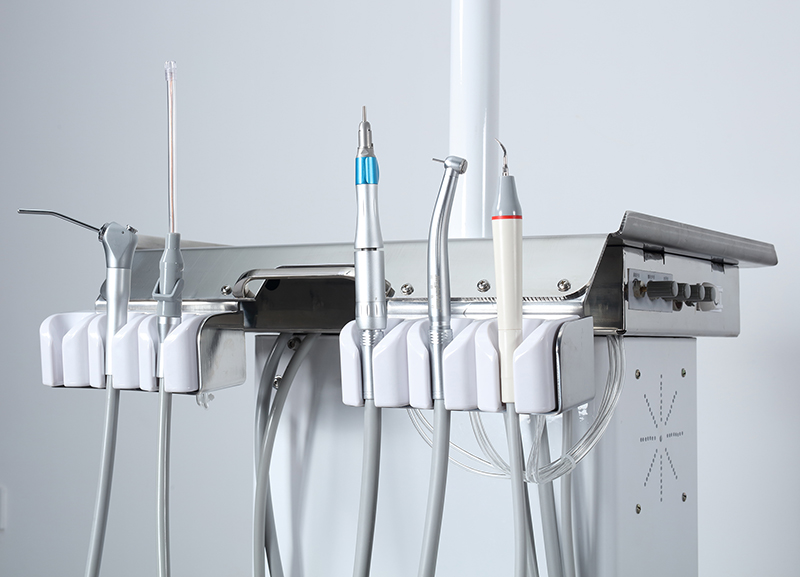
The position of the instrument holders, stainless steel tray, control panel and bottles affects daily efficiency. A compact unit should still allow staff to reach instruments without crossing hoses or blocking movement around the patient table.
If possible, request a short operating video showing how the unit is moved, how instruments are removed from their holders, how the compressor starts and how the clean and waste water bottles are serviced. This provides more practical information than a white-background product photo alone.
Before ordering, provide the supplier with the destination country and required voltage. Confirm the plug type, frequency, total electrical requirements and whether any accessories require a separate power connection.
For configurations that include an X-ray module, the buyer should confirm local registration, documentation, installation and operating requirements before placing the order. Product availability and required documentation may vary by destination market.
A complete purchasing decision should include after-sales support, not only the equipment price. Ask the supplier to provide:
| Item to Confirm | Questions to Ask |
|---|---|
| Dimensions and mobility | Will it fit the treatment room, doors and movement route? Do all casters have suitable locking or braking functions? |
| Air supply | Is the compressor built in? What are its power, tank, pressure and noise specifications? |
| Water system | Are clean and waste water bottles included? What is their capacity and cleaning procedure? |
| Standard equipment | Which instruments are included in the quoted price? |
| Optional equipment | Can it support the required light, curing light, camera, X-ray and handpieces? |
| Electrical requirements | Are the voltage, frequency and plug suitable for the destination clinic? |
| Documentation | Are manuals, packing information, warranty terms and required documents available? |
The JingleMed V2 Series is designed as a compact, mobile veterinary dental treatment table for clinics that want to add dental equipment with less installation work. It combines a built-in oil-free air compressor, clean water bottle, waste water bottle, stainless steel instrument tray, ultrasonic scaler, 3-way syringe and weak suction in one mobile platform.
The three versions use the same main platform:
Base mobile veterinary dental treatment table for clinics that need a compact treatment workstation.
V2 platform with an integrated dental light for oral examination and dental procedures.
V2 platform with an X-ray module, subject to the destination market and local requirements.
View the V2 Series Veterinary Dental Treatment Table
A mobile cart is suitable when mobility and a compact footprint are the priorities. If the clinic needs a single workstation that combines an electric height-adjustable surgical or treatment table with dental instruments and a dental light, an integrated system may be more appropriate. See the AWT-V1 integrated veterinary surgical and dental treatment table for comparison.
It depends on the model. A unit with a built-in oil-free air compressor does not require a separate external compressed-air source for its standard air-supply configuration. Confirm handpiece compatibility and electrical requirements with the supplier.
Common functions include an ultrasonic scaler, 3-way syringe, suction, clean and waste water bottles and handpiece connections. Dental lights, curing lights, intraoral cameras, X-ray modules and handpieces may be standard or optional depending on the model.
A compact self-contained unit can be suitable when the clinic has limited space or wants to avoid installing a separate air line and fixed plumbing. The clinic should still confirm power, ventilation, access, workflow and local safety requirements.
Choose V2 for the base mobile dental treatment platform, V2-1 when an integrated dental light is required, and V2-X when the clinic needs the X-ray configuration and can meet the destination-market requirements.
Before requesting a quotation, prepare your destination country, voltage, required quantity, available treatment-room space and list of required instruments. JingleMed can then recommend a suitable V2 Series configuration and confirm which accessories are standard or optional.